
![]()
![]()
How can artificial intelligence unlock more inclusive opportunities in digital trade? What capabilities do countries need to thrive in the AI era?
These questions were at the heart of the program of Capacity Building on AI-Driven Digital Trade held in Xi'an, Shaanxi province, on July 21. This program is a featured event of the 2026 World Internet Conference (WIC) Digital Silk Road Development Forum.
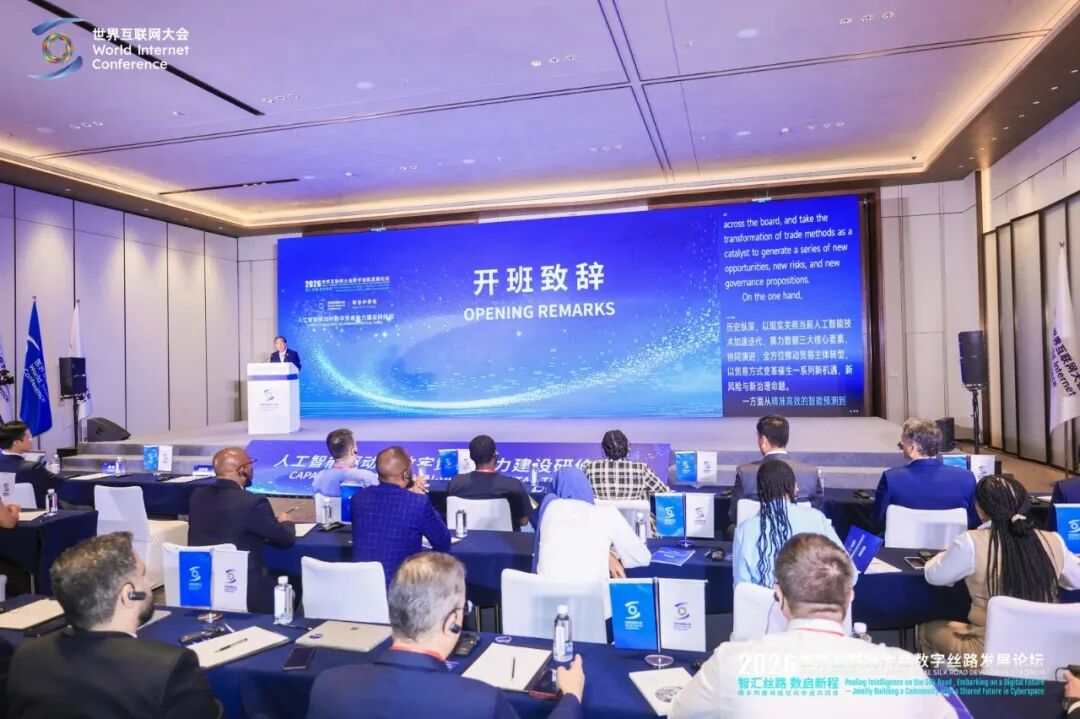
Bringing together four leading experts and nearly 50 participants from more than 20 countries and regions, the program explored practical pathways for AI-enabled digital trade, equipping participants with the knowledge and skills to navigate the rapidly evolving digital economy.
Opening the program, Ren Xianliang, secretary-general of the WIC, said AI is reshaping global trade, while the digital and AI divide remains a pressing challenge. He stressed that only through openness, inclusiveness, equal dialogue and closer collaboration can the benefits of technological innovation be translated into new momentum for inclusive global development.
Cross-border data flows: Laying the foundation for digital trade
At its core, digital trade is driven by the flow of data, yet fragmented regulatory frameworks continue to present major compliance challenges for businesses operating across borders.
Lin Zhiqiang, division director for the Data and Technical Support Center of the Cyberspace Administration of China, outlined China's approach to cross-border data governance, explaining how the country’s regulatory framework seeks to balance development with security.
He reviewed the different regulatory models adopted by major economies and explained how China's framework — combining differentiated regulation, multiple compliance pathways and a negative list for pilot free trade zones — helps reduce compliance costs for small and medium-sized enterprises while offering a useful reference for countries seeking to strengthen their own data governance frameworks.
Building consensus on rules for the AI era
Secure data flows alone are not enough. As AI becomes increasingly embedded in digital trade, common standards and trusted governance are equally essential.
In an interview during the program, John Higgins, co-lead of the Standards Program of the WIC Specialized Committee on Artificial Intelligence and chair of the International AI Governance Association, said the AI era and digital era are just more accelerated eras of trade, but it’s very difficult to engage in trade and take advantage of AI if countries don’t have the basics in place. “It seems to me the basics are still the basics that need to be addressed,” he said.
He called on countries to uphold the well-established international trade framework under the World Trade Organization while strengthening policy frameworks in emerging areas such as cross-border data flows and cybersecurity to build a solid foundation for secure digital trade. Higgins also encouraged participants to actively engage in exchange programs hosted by the WIC and its Digital & AI Academy, translating what they have learned into practical solutions for advancing digital trade in their own countries and reducing barriers to technology adoption through greater regulatory alignment.
From AI innovation to industrial transformation
Rules and technologies ultimately need to create value in the real economy.
Song Juntao, vice-chair of the WIC Specialized Committee on E-commerce and former secretary-general of the Electronic World Trade Platform, focused on the future of cross-border e-commerce, demonstrating how AI is reshaping business models across the entire value chain.
He noted that the program provided a valuable platform where participants could come together, exchange diverse perspectives, and put forward different ideas. Such exchanges, he noted, are integral to capacity building and talent development, which form the cornerstone of a country‘s long-term competitiveness.
For many participants, the discussions offered practical ideas that could be applied at home.
Waeng Tumelo Primrose, principal administration officer under the Ministry of Child Welfare and Basic Education of Botswana, said Botswana plans to draw on the experience gained during the program to develop online platforms that will help farmers and craftsmen market their businesses online, and sell local products to international markets.
Mokhethi Thato Florence Khetsi, assistant human resources officer under the Ministry of Information, Communications, Science, Technology and Innovation of Lesotho, said she was particularly impressed by AI’s potential to be a cheaper form of advertisement. AI-powered tools, she said, could enable local small businesses to advertise their businesses to global markets more efficiently while creating new employment opportunities for young people and women.
Capacity building: Making AI work for all
Ensuring that developing countries can benefit from AI is central to building a more inclusive Digital Silk Road.
Nishtha Mehta, international senior advisor for the Centers of Excellence for AI and Digital Transformation at the United Nations Industrial Development Organization, shared examples of how inclusive AI is supporting sustainable industrialization across the Global South.
She emphasized that technology alone is not enough. The key, she said, is to develop solutions tailored to local strengths and development needs, enabling AI to support a wide range of sectors — from education and manufacturing to cybersecurity — and deliver tangible benefits to communities.
Participants echoed the importance of international cooperation and knowledge sharing.
Malachy Chinedu Onyike, secretary to the governing council of Anambra State Investment Promotion and Protection Agency under Nigeria‘s Anambra State Government, said the program provided a platform for interaction among people from different countries. “When people from different countries and different organizations come together to share experiences, they learn from one another’s mistakes, and then go back to their own country and implement all those policies,” he said.
Steven Ferewa Kamara, performance manager at the Office of the President of the Government of Sierra Leone, described the program as both insightful and important. He said the program can help people to easily understand the standards and practical approaches to digital trade. “I look forward to applying what I have learned to support Sierra Leone's economic and social development,” he added.
Held in Xi'an, the historic starting point of the ancient Silk Road, the program offered more than technical knowledge. It brought together global expertise and practical experience while encouraging participants to explore development paths tailored to their own national priorities.
As Ren, secretary-general of the WIC, noted in his opening remarks, stronger infrastructure, greater consensus on rules, wider industrial adoption and continued investment in digital talent cultivation are all essential to unlocking the full potential of AI-driven digital trade.
Click the "read more" button at the end of article to learn more