
YouTube网红小哥Siraj Raval系列视频又和大家见面啦!今天要讲的是加密货币价格预测,包含大量代码,还用一个视频详解具体步骤,不信你看了还学不会!
点击观看详解视频
时长22分钟
有中文字幕
▼
预测加密货币价格其实很简单,用Python+Keras,再来一个循环神经网络(确切说是双向LSTM),只需要9步就可以了!比特币以太坊价格预测都不在话下。
这9个步骤是:
数据处理
建模
训练模型
测试模型
分析价格变化
分析价格百分比变化
比较预测值和实际数据
计算模型评估指标
结合在一起:可视化

导入Keras、Scikit learn的metrics、numpy、pandas、matplotlib这些我们需要的库。
## Keras for deep learning
from keras.layers.core import Dense, Activation, Dropout
from keras.layers.recurrent import LSTM
from keras.layers import Bidirectional
from keras.models import Sequential

## Scikit learn for mapping metrics
from sklearn.metrics import mean_squared_error

#for logging
import time

##matrix math
import numpy as np
import math

##plotting
import matplotlib.pyplot as plt

##data processing
import pandas as pd
首先,要对数据进行归一化处理。关于数据处理的原则,有张大图,大家可以在大数据文摘公众号后台对话框内回复“加密货币”查看高清图。

def load_data(filename, sequence_length):
"""
Loads the bitcoin data
Arguments:
filename -- A string that represents where the .csv file can be located
sequence_length -- An integer of how many days should be looked at in a row
Returns:
X_train -- A tensor of shape (2400, 49, 35) that will be inputed into the model to train it
Y_train -- A tensor of shape (2400,) that will be inputed into the model to train it
X_test -- A tensor of shape (267, 49, 35) that will be used to test the model's proficiency
Y_test -- A tensor of shape (267,) that will be used to check the model's predictions
Y_daybefore -- A tensor of shape (267,) that represents the price of bitcoin the day before each Y_test value
unnormalized_bases -- A tensor of shape (267,) that will be used to get the true prices from the normalized ones
window_size -- An integer that represents how many days of X values the model can look at at once
"""
#Read the data file
raw_data = pd.read_csv(filename, dtype = float).values
#Change all zeros to the number before the zero occurs
for x in range(0, raw_data.shape[0]):
for y in range(0, raw_data.shape[1]):
if(raw_data[x][y] == 0):
raw_data[x][y] = raw_data[x-1][y]
#Convert the file to a list
data = raw_data.tolist()
#Convert the data to a 3D array (a x b x c)
#Where a is the number of days, b is the window size, and c is the number of features in the data file
result = []
for index in range(len(data) - sequence_length):
result.append(data[index: index + sequence_length])
#Normalizing data by going through each window
#Every value in the window is divided by the first value in the window, and then 1 is subtracted
d0 = np.array(result)
dr = np.zeros_like(d0)
dr[:,1:,:] = d0[:,1:,:] / d0[:,0:1,:] - 1
#Keeping the unnormalized prices for Y_test
#Useful when graphing bitcoin price over time later
start = 2400
end = int(dr.shape[0] + 1)
unnormalized_bases = d0[start:end,0:1,20]
#Splitting data set into training (First 90% of data points) and testing data (last 10% of data points)
split_line = round(0.9 * dr.shape[0])
training_data = dr[:int(split_line), :]
#Shuffle the data
np.random.shuffle(training_data)
#Training Data
X_train = training_data[:, :-1]
Y_train = training_data[:, -1]
Y_train = Y_train[:, 20]
#Testing data
X_test = dr[int(split_line):, :-1]
Y_test = dr[int(split_line):, 49, :]
Y_test = Y_test[:, 20]
#Get the day before Y_test's price
Y_daybefore = dr[int(split_line):, 48, :]
Y_daybefore = Y_daybefore[:, 20]
#Get window size and sequence length
sequence_length = sequence_length
window_size = sequence_length - 1 #because the last value is reserved as the y value
return X_train, Y_train, X_test, Y_test, Y_daybefore, unnormalized_bases, window_size
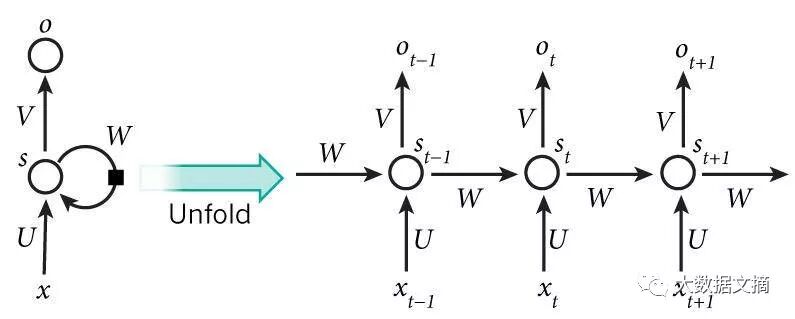
我们用到的是一个3层RNN,dropout率20%。
双向RNN基于这样的想法:时间t的输出不仅依赖于序列中的前一个元素,而且还可以取决于未来的元素。比如,要预测一个序列中缺失的单词,需要查看左侧和右侧的上下文。双向RNN是两个堆叠在一起的RNN,根据两个RNN的隐藏状态计算输出。
举个例子,这句话里缺失的单词gym要查看上下文才能知道(文摘菌:everyday?):
I go to the ( ) everyday to get fit.
def initialize_model(window_size, dropout_value, activation_function, loss_function, optimizer):
    """
    Initializes and creates the model to be used

    Arguments:
    window_size -- An integer that represents how many days of X_values the model can look at at once
    dropout_value -- A decimal representing how much dropout should be incorporated at each level, in this case 0.2
    activation_function -- A string to define the activation_function, in this case it is linear
    loss_function -- A string to define the loss function to be used, in the case it is mean squared error
    optimizer -- A string to define the optimizer to be used, in the case it is adam

    Returns:
    model -- A 3 layer RNN with 100*dropout_value dropout in each layer that uses activation_function as its activation
             function, loss_function as its loss function, and optimizer as its optimizer
    """
    #Create a Sequential model using Keras
    model = Sequential()

    #First recurrent layer with dropout
    model.add(Bidirectional(LSTM(window_size, return_sequences=True), input_shape=(window_size, X_train.shape[-1]),))
    model.add(Dropout(dropout_value))

    #Second recurrent layer with dropout
    model.add(Bidirectional(LSTM((window_size*2), return_sequences=True)))
    model.add(Dropout(dropout_value))

    #Third recurrent layer
    model.add(Bidirectional(LSTM(window_size, return_sequences=False)))

    #Output layer (returns the predicted value)
    model.add(Dense(units=1))

    #Set activation function
    model.add(Activation(activation_function))

    #Set loss function and optimizer
    model.compile(loss=loss_function, optimizer=optimizer)

    return model
这里取batch size = 1024,epoch times = 100。我们需要最小化均方误差MSE。
def fit_model(model, X_train, Y_train, batch_num, num_epoch, val_split):
    """
    Fits the model to the training data

    Arguments:
    model -- The previously initalized 3 layer Recurrent Neural Network
    X_train -- A tensor of shape (2400, 49, 35) that represents the x values of the training data
    Y_train -- A tensor of shape (2400,) that represents the y values of the training data
    batch_num -- An integer representing the batch size to be used, in this case 1024
    num_epoch -- An integer defining the number of epochs to be run, in this case 100
    val_split -- A decimal representing the proportion of training data to be used as validation data

    Returns:
    model -- The 3 layer Recurrent Neural Network that has been fitted to the training data
    training_time -- An integer representing the amount of time (in seconds) that the model was training
    """
    #Record the time the model starts training
    start = time.time()

    #Train the model on X_train and Y_train
    model.fit(X_train, Y_train, batch_size= batch_num, nb_epoch=num_epoch, validation_split= val_split)

    #Get the time it took to train the model (in seconds)
    training_time = int(math.floor(time.time() - start))
    return model, training_time
def test_model(model, X_test, Y_test, unnormalized_bases):
"""
Test the model on the testing data
Arguments:
model -- The previously fitted 3 layer Recurrent Neural Network
X_test -- A tensor of shape (267, 49, 35) that represents the x values of the testing data
Y_test -- A tensor of shape (267,) that represents the y values of the testing data
unnormalized_bases -- A tensor of shape (267,) that can be used to get unnormalized data points
Returns:
y_predict -- A tensor of shape (267,) that represnts the normalized values that the model predicts based on X_test
real_y_test -- A tensor of shape (267,) that represents the actual prices of bitcoin throughout the testing period
real_y_predict -- A tensor of shape (267,) that represents the model's predicted prices of bitcoin
fig -- A branch of the graph of the real predicted prices of bitcoin versus the real prices of bitcoin
"""
#Test the model on X_Test
y_predict = model.predict(X_test)
#Create empty 2D arrays to store unnormalized values
real_y_test = np.zeros_like(Y_test)
real_y_predict = np.zeros_like(y_predict)
#Fill the 2D arrays with the real value and the predicted value by reversing the normalization process
for i in range(Y_test.shape[0]):
y = Y_test[i]
predict = y_predict[i]
real_y_test[i] = (y+1)*unnormalized_bases[i]
real_y_predict[i] = (predict+1)*unnormalized_bases[i]
#Plot of the predicted prices versus the real prices
fig = plt.figure(figsize=(10,5))
ax = fig.add_subplot(111)
ax.set_title("Bitcoin Price Over Time")
plt.plot(real_y_predict, color = 'green', label = 'Predicted Price')
plt.plot(real_y_test, color = 'red', label = 'Real Price')
ax.set_ylabel("Price (USD)")
ax.set_xlabel("Time (Days)")
ax.legend()
return y_predict, real_y_test, real_y_predict, fig
def price_change(Y_daybefore, Y_test, y_predict):
"""
Calculate the percent change between each value and the day before
Arguments:
Y_daybefore -- A tensor of shape (267,) that represents the prices of each day before each price in Y_test
Y_test -- A tensor of shape (267,) that represents the normalized y values of the testing data
y_predict -- A tensor of shape (267,) that represents the normalized y values of the model's predictions
Returns:
Y_daybefore -- A tensor of shape (267, 1) that represents the prices of each day before each price in Y_test
Y_test -- A tensor of shape (267, 1) that represents the normalized y values of the testing data
delta_predict -- A tensor of shape (267, 1) that represents the difference between predicted and day before values
delta_real -- A tensor of shape (267, 1) that represents the difference between real and day before values
fig -- A plot representing percent change in bitcoin price per day,
"""
#Reshaping Y_daybefore and Y_test
Y_daybefore = np.reshape(Y_daybefore, (-1, 1))
Y_test = np.reshape(Y_test, (-1, 1))
#The difference between each predicted value and the value from the day before
delta_predict = (y_predict - Y_daybefore) / (1+Y_daybefore)
#The difference between each true value and the value from the day before
delta_real = (Y_test - Y_daybefore) / (1+Y_daybefore)
#Plotting the predicted percent change versus the real percent change
fig = plt.figure(figsize=(10, 6))
ax = fig.add_subplot(111)
ax.set_title("Percent Change in Bitcoin Price Per Day")
plt.plot(delta_predict, color='green', label = 'Predicted Percent Change')
plt.plot(delta_real, color='red', label = 'Real Percent Change')
plt.ylabel("Percent Change")
plt.xlabel("Time (Days)")
ax.legend()
plt.show()
return Y_daybefore, Y_test, delta_predict, delta_real, fig
def binary_price(delta_predict, delta_real):
    """
    Converts percent change to a binary 1 or 0, where 1 is an increase and 0 is a decrease/no change

    Arguments:
    delta_predict -- A tensor of shape (267, 1) that represents the predicted percent change in price
    delta_real -- A tensor of shape (267, 1) that represents the real percent change in price

    Returns:
    delta_predict_1_0 -- A tensor of shape (267, 1) that represents the binary version of delta_predict
    delta_real_1_0 -- A tensor of shape (267, 1) that represents the binary version of delta_real
    """
    #Empty arrays where a 1 represents an increase in price and a 0 represents a decrease in price
    delta_predict_1_0 = np.empty(delta_predict.shape)
    delta_real_1_0 = np.empty(delta_real.shape)

    #If the change in price is greater than zero, store it as a 1
    #If the change in price is less than zero, store it as a 0
    for i in range(delta_predict.shape[0]):
        if delta_predict[i][0] > 0:
            delta_predict_1_0[i][0] = 1
        else:
            delta_predict_1_0[i][0] = 0
    for i in range(delta_real.shape[0]):
        if delta_real[i][0] > 0:
            delta_real_1_0[i][0] = 1
        else:
            delta_real_1_0[i][0] = 0

    return delta_predict_1_0, delta_real_1_0
def find_positives_negatives(delta_predict_1_0, delta_real_1_0):
"""
Finding the number of false positives, false
negatives, true positives, true negatives
Arguments:
delta_predict_1_0 -- A tensor of shape (267, 1) that represents the binary version of delta_predict
delta_real_1_0 -- A tensor of shape (267, 1) that represents the binary version of delta_real
Returns:
true_pos -- An integer that represents the number of true positives achieved by the model
false_pos -- An integer that represents the number of false positives achieved by the model
true_neg -- An integer that represents the number of true negatives achieved by the model
false_neg -- An integer that represents the number of false negatives achieved by the model
"""
#Finding the number of false positive/negatives and true positives/negatives
true_pos = 0
false_pos = 0
true_neg = 0
false_neg = 0
for i in range(delta_real_1_0.shape[0]):
real = delta_real_1_0[i][0]
predicted = delta_predict_1_0[i][0]
if real == 1:
if predicted == 1:
true_pos += 1
else:
false_neg += 1
elif real == 0:
if predicted == 0:
true_neg += 1
else:
false_pos += 1
return true_pos, false_pos, true_neg, false_neg
def calculate_statistics(true_pos, false_pos, true_neg, false_neg, y_predict, Y_test):
"""
Calculate various statistics to assess performance
Arguments:
true_pos -- An integer that represents the number of true positives achieved by the model
false_pos -- An integer that represents the number of false positives achieved by the model
true_neg -- An integer that represents the number of true negatives achieved by the model
false_neg -- An integer that represents the number of false negatives achieved by the model
Y_test -- A tensor of shape (267, 1) that represents the normalized y values of the testing data
y_predict -- A tensor of shape (267, 1) that represents the normalized y values of the model's predictions
Returns:
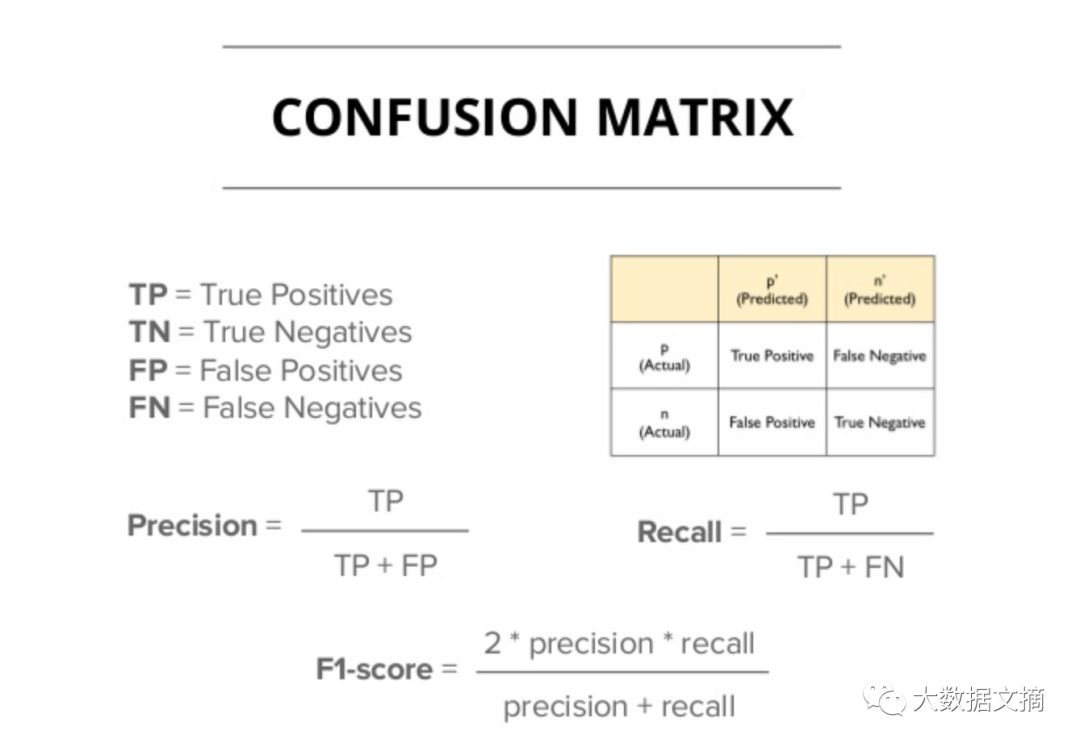
precision -- How often the model gets a true positive compared to how often it returns a positive
recall -- How often the model gets a true positive compared to how often is hould have gotten a positive
F1 -- The weighted average of recall and precision
Mean Squared Error -- The average of the squares of the differences between predicted and real values
"""
precision =
float(true_pos) / (true_pos + false_pos)
recall = float(true_pos) / (true_pos + false_neg)
F1 = float(2 * precision * recall) / (precision + recall)
#Get Mean Squared Error
MSE = mean_squared_error(y_predict.flatten(), Y_test.flatten())
return precision, recall, F1, MSE
终于可以看看我们的成果啦!
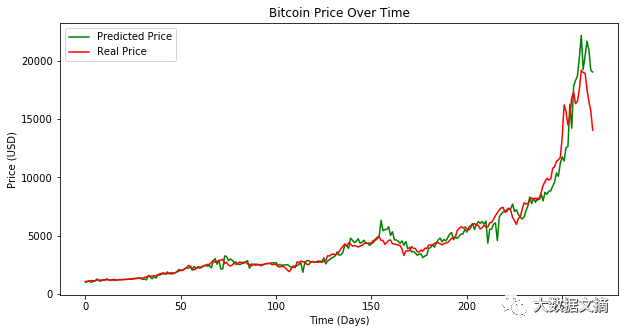
首先是预测价格vs实际价格:
y_predict, real_y_test, real_y_predict, fig1 = test_model(model, X_test, Y_test, unnormalized_bases)

#Show the plot
plt.show(fig1)
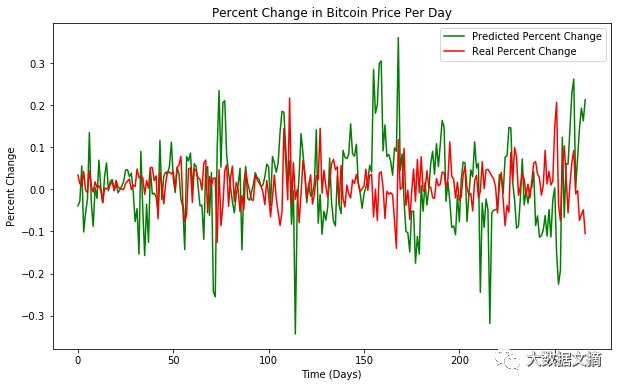
然后是预测的百分比变化vs实际的百分比变化,值得注意的是,这里的预测相对实际来说波动更大,这是模型可以提高的部分:
Y_daybefore, Y_test, delta_predict, delta_real, fig2 = price_change(Y_daybefore, Y_test, y_predict)

#Show the plot
plt.show(fig2)
最终模型表现是这样的:
Precision: 0.62
Recall: 0.553571428571
F1 score: 0.584905660377
Mean Squared Error: 0.0430756924477
怎么样,看完有没有跃跃欲试呢?
代码下载地址:
https://github.com/llSourcell/ethereum_future/blob/master/A%20Deep%20Learning%20Approach%20to%20Predicting%20Cryptocurrency%20Prices.ipynb
原视频地址:
https://www.youtube.com/watch?v=G5Mx7yYdEhE
作 者 | Siraj Raval 大数据文摘经授权译制
翻 译 | 糖竹子、狗小白、邓子稷
时间轴 | 韩振峰、Barbara、菜菜Tom
监 制 | 龙牧雪
【今日机器学习概念】
Have a Great Definition